
SC250
South Carolina's first year in the American Revolution

The South Carolina American Revolution Sestercentennial Commission is part of the nonpartisan America250 initiative, celebrating and promoting South Carolina’s role in the American Revolution through education and supporting commemorative events, arts, preservation, heritage tourism infrastructure, and corresponding economic development.

After years of increasing hostility between citizens of the American colonies and the British crown, 1775 was the breaking point. As Patriot and Loyalist factions grew, battles and skirmishes occurred, pitting neighbor against neighbor. More Revolutionary War battles were fought in South Carolina than in any other colony, with 30% of the war’s casualties occurring here.

Located on James Island, Fort Johnson was occupied by the British in 1775 until the 2nd South Carolina Regiment, commanded by Colonel William Moultrie, took the fort. The British were alerted ahead of time and abandoned the fort before the colonial forces arrived.

Not long after American forces had taken Fort Johnson, the British sloop-of-war HMS Cherokee arrived offshore. In order to signal that the fort was commanded by Patriots, Col. Moultrie was assigned to design a flag for South Carolina. To mirror the uniforms soldiers of the 1st and 2nd SC Regiments wore, it was dyed with indigo and had a silver crescent in one corner. This was the first American flag to fly in South Carolina.
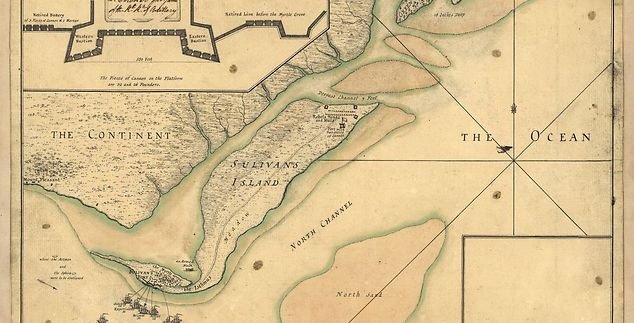
John Allston of the Georgetown District Regiment led a Patriot unit of 54 Native Americans called the “Raccoon Company,” earning him the moniker “Captain Jack of the Raccoon Guards.” On December 19th, 1775, the militia attacked British troops camped on Sullivan’s Island. Allston and his faction burned down British structures and killed four runaway enslaved persons. Eleven people were captured by the Natives, three of which were crew from the HMS Cherokee.

South Carolina was a pivotal part of the Revolutionary War, and 1775 was truly only the beginning of our story in securing independence. Featured at the South Carolina Military Museum is a reproduction 6-pounder field gun known as "Boots" who travels with living historians to re-enactment battles across the state.